Solutions

Built for the people who have to answer for materials.

Different teams, different pressure, same missing capability: a way to check what a fabric is at the moment a decision depends on it.

Who this is for

Five environments, one missing evidence layer.

Consumer health & transparency

Give an explanation platform physical evidence it can independently interpret.

Consumer tools often work from literature, brand disclosures, certifications and regulatory sources. Weft introduces a different input: a reading from the specific garment or controlled sample, linked to its provenance and limitations.

Explore the partnership model

Brands & retailers

Sourcing, quality and compliance

You publish material claims across thousands of styles and stand behind every one. Weft gives your inspectors a check they can run themselves, and gives your compliance team a record that holds up when a retailer, an auditor or a regulator asks how you knew.

Manufacturers

Mills and finished-goods suppliers

Your customers increasingly ask you to prove what you sent them. Reading your own output before it ships turns a defensive conversation into a document, and catches an incoming yarn substitution before it becomes your problem.

Resale & rental

Recommerce platforms

Half of what arrives at intake has no readable label. Composition at the bench means listings that describe the item accurately, fewer condition disputes, and a defensible answer when a seller and a buyer disagree.

Circularity

Sorters, recyclers and reverse logistics

Feedstock value depends on knowing composition, and labels are the least reliable thing in the bale. Reading material rather than trusting it raises yield and gives downstream processors a record they can price against.

Commercial use cases

Where the money actually moves.

These are the situations customers describe when they explain why they went looking for something like this in the first place.

SituationWhat happens todayWhat Weft changes
Fibre substitution in production Found after delivery, usually by a customer. Handled as a markdown or a recall. Found at final inspection, while the goods are still the supplier’s problem.
Retailer material questionnaire Weeks of chasing certificates across a supplier list, assembled by hand. An export from records already generated in the normal course of work.
Testing budget review A fixed sample rate applied evenly, mostly confirming what was already true. The same budget aimed at the styles where a wrong answer costs the most.
Intake at a resale hub Composition guessed from feel and brand, or the field left blank. Measured at the bench in seconds and written straight to the listing.
Customer complaint about a reaction No evidence of what the garment contains beyond the label being disputed. A measurement of the actual product, on file, taken before the complaint existed.
Recycled-content claims Accepted on paper because there is no practical way to check downstream. Screened at scale, with the doubtful cases sent for confirmation.
Consumer material explanation General fibre guidance is presented without object-level evidence about the garment in hand. A verified composition record can be translated independently, with provenance and limits attached.
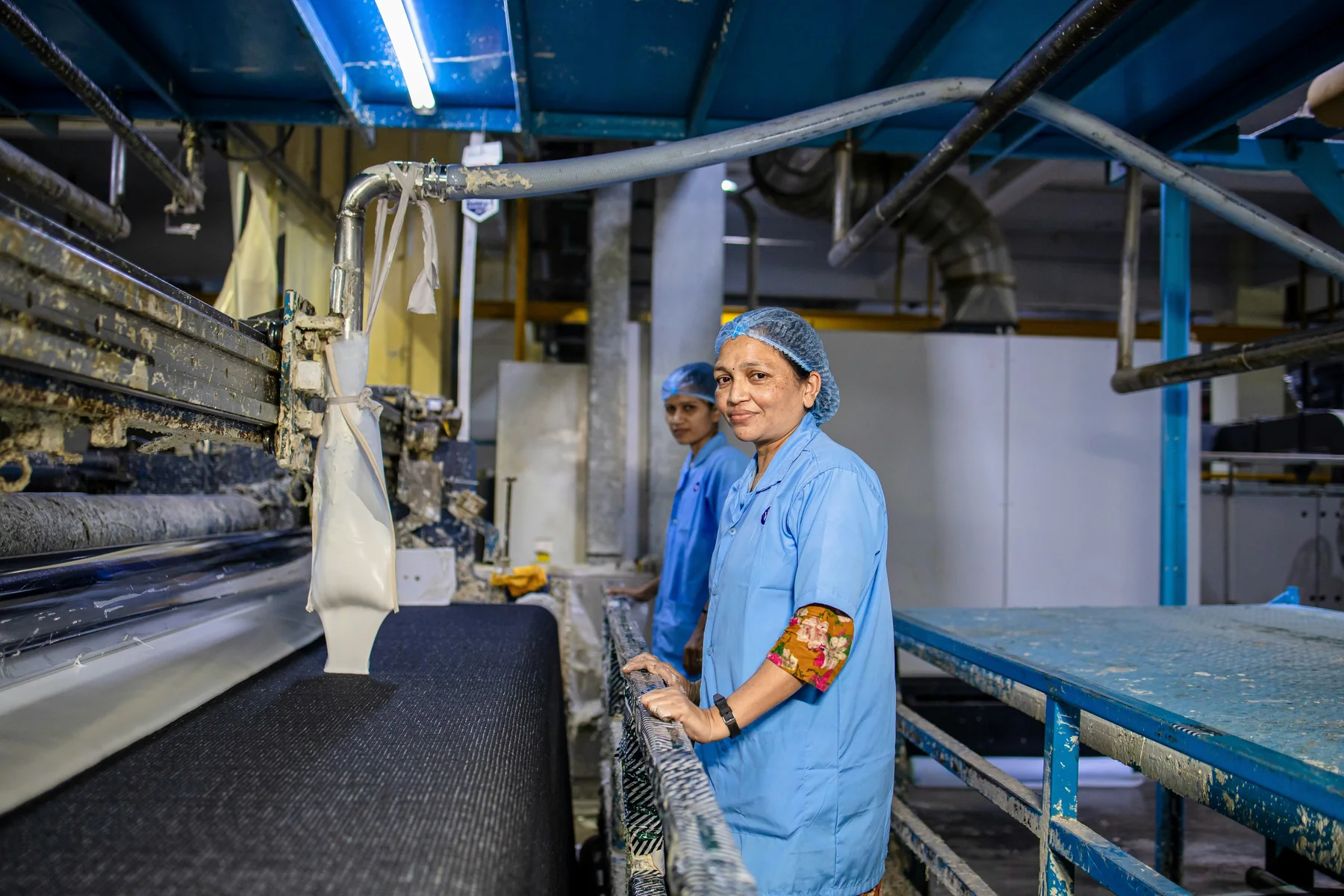
Textile production team working beside industrial machinery
Start with one category and one point of inspection, then widen from evidence rather than assumption.

Deployment

Start narrow. Widen once it has earned it.

We would rather prove this on one product family than sell you a programme. A first deployment is usually a single site, a handful of readers and one category where you already suspect the declarations are soft.

From there it spreads the way useful tools spread — because the team next door asked for one.

  • Week one

    Readers arrive configured. Tolerances set with your quality lead. First comparisons against live production.

  • Month one

    Declaration data connected from your PLM or supplier submissions. Exceptions routed to named owners.

  • Quarter one

    Testing queue tuned against your own lab results. First audit export produced from real records.

Why buyers sign

The case that survives a procurement review.

It replaces a cost you already carry

Per-sample laboratory spend is a line item every quality team can find. Weft redirects it rather than adding to it.

It reduces exposure you cannot insure away

Material claims are a documented liability. Evidence generated in-house is worth more than assurances passed along a supply chain.

It works without a transformation programme

No new department, no eighteen-month rollout. One reader, one bench, one product family is a valid starting point.

It leaves you with the data

Readings and records export cleanly. Nothing about this is designed to make leaving difficult.

It is honest about its limits

We publish where the reader is strong and where it is not. That is the only basis on which a quality team can adopt anything.

It gets better with your results

Every laboratory confirmation you feed back sharpens the ranking that decides what to test next season.

Tell us which material question your current evidence cannot answer.

We will be direct about whether this helps. Sometimes the answer is a laboratory contract and better supplier terms, and we will say so.